








What Is Omaha Poker?
Overview of Omaha Poker
Omaha is a community card poker variant where each player receives four private cards. Over the course of the hand, five community cards are dealt face up on the table, and players form the best possible five-card combination from what’s available to them.
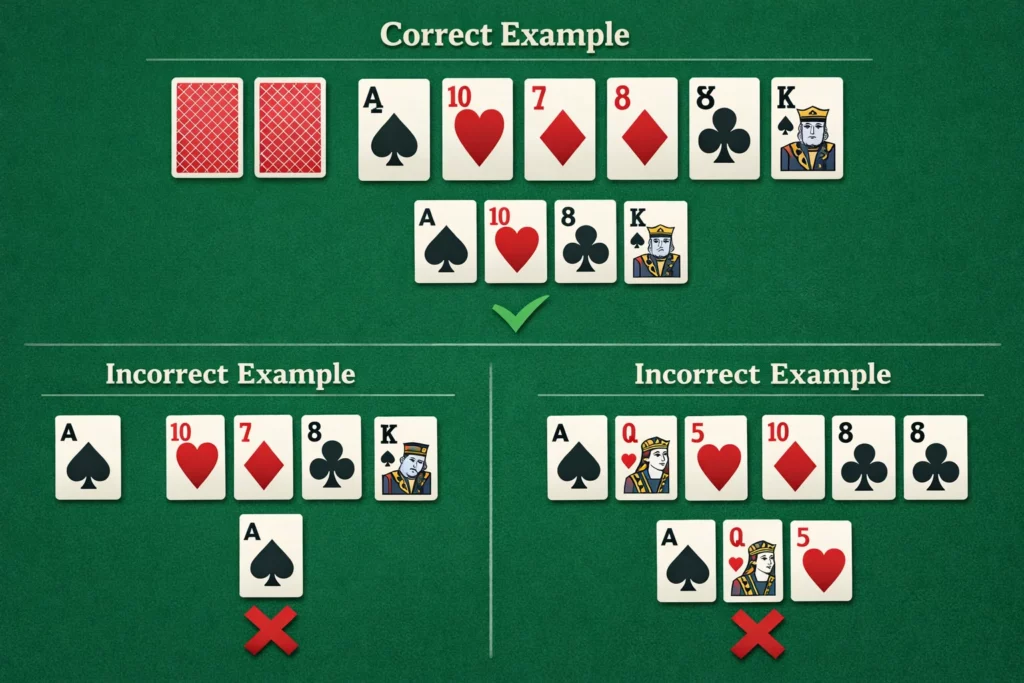
The rule that defines the entire game is simple to state: you must use exactly two of your hole cards and exactly three community cards, no more and no fewer. It doesn’t matter how strong a hand looks using a different split; only combinations built on that exact 2-and-3 structure count.
Everything else in the setup will feel familiar if you’ve played Hold’em:
- a dealer button that rotates each hand;
- a small blind and big blind;
- four betting rounds;
- a showdown if more than one player remains.
Hand rankings are the same as in other standard poker games. From Royal Flush down to High Card, the order doesn’t change. You can find the formal ranking breakdown in sources like Wikipedia’s List of poker hands.
What does change is how often those hands show up. In Omaha, strong combinations happen frequently, since every player is working with four cards instead of two. Two pair, which might look decent in Hold’em, often isn’t enough here, and hand strength shifts faster from street to street than most Hold’em players expect at first.
Omaha Poker Rules Explained
The Deal & Blinds
Every hand begins with two forced bets: the small blind and the big blind. These create action and ensure there’s something to play for immediately.
Once blinds are posted, each player receives four cards. At this point, many beginners make their first mistake: they see four decent-looking cards and assume the hand must be playable. In Omaha, that’s not always true.
Four high cards that don’t connect can be surprisingly weak. A coordinated hand with straight and flush potential can become very strong instead, even if it doesn’t look flashy at first glance.
Betting Rounds
The flow of the hand follows four familiar stages:
- Pre-flop: players act after seeing their four hole cards.
- Flop: three community cards are revealed.
- Turn: a fourth card appears.
- River: the final community card completes the board.
At each stage, players can fold, check, call, or raise.
Because everyone holds more cards, flops in Omaha tend to create action. It’s common for multiple players to have straight draws, flush draws, or even made hands at the same time, which is why pots can grow quickly compared to Hold’em.
Showdown & Winning Hands
If the hand reaches the river and more than one player is still in, cards are revealed. The strongest valid five-card hand wins.
The word “valid” matters. You must use exactly two hole cards and three board cards. Even if it looks like you have a monster hand using three of your private cards, it doesn’t count.
Many early frustrations in Omaha come from misreading your own hand. Taking an extra second to confirm which two hole cards you’re actually using can save costly mistakes. Check out our Omaha poker strategy guide to improve your game.
Hand Ranking System (Same as Hold’em)
The ranking system in Omaha does not change:
| Rank | Hand |
| 1 | Royal Flush |
| 2 | Straight Flush |
| 3 | Four of a Kind |
| 4 | Full House |
| 5 | Flush |
| 6 | Straight |
| 7 | Three of a Kind |
| 8 | Two Pair |
| 9 | One Pair |
| 10 | High Card |
The difference isn’t in the rankings. It’s in how strong your hand needs to be to win, since more cards in play means opponents complete big hands more often.
Key Rule: 2 Hole Cards + 3 Board Cards
Why This Rule Matters
This rule is the foundation of Omaha strategy. With four cards in your hand, it’s easy to imagine dozens of possible combinations, but only certain two-card pairings are legal. That forces you to constantly evaluate which two cards from your hand actually work best with the board, hand after hand.
This affects everything, from calculating a flush to evaluating whether your straight is really the nuts. A board that looks safe can easily complete powerful combinations for other players, since they’re drawing from four cards too.
In Omaha, careful board reading is not optional. Learn more about Omaha vs Texas to sharpen your strategy.
Common Omaha Misunderstandings
Players new to the game often:
- forget the exact 2+3 rule;
- overvalue top pair;
- play too many starting hands;
- ignore how connected the board is.
Because strong hands are common, marginal ones lose value quickly, and patience matters more here than it does in Hold’em.
Legal vs Illegal Hands: A Worked Example
Take a hand of A♠ K♠ Q♦ J♦ with a board reading T♦ 9♣ 8♠ 3♥ 2♣. A legal combination is Q♦ J♦ from your hand plus T♦ 9♣ 8♠ from the board: five cards total, forming a Q-high straight.
An illegal combination would be Q♦ J♦ T♦ from your hand plus 9♣ 8♠ from the board, even though it produces the exact same straight on paper. It doesn’t count, because it breaks the 2-and-3 split. Just as illegal: using only A♠ from your hand alongside four community cards. Either way, the rule stays fixed at exactly two from your hand and exactly three from the board.
Omaha Variants
Pot-Limit Omaha (PLO)
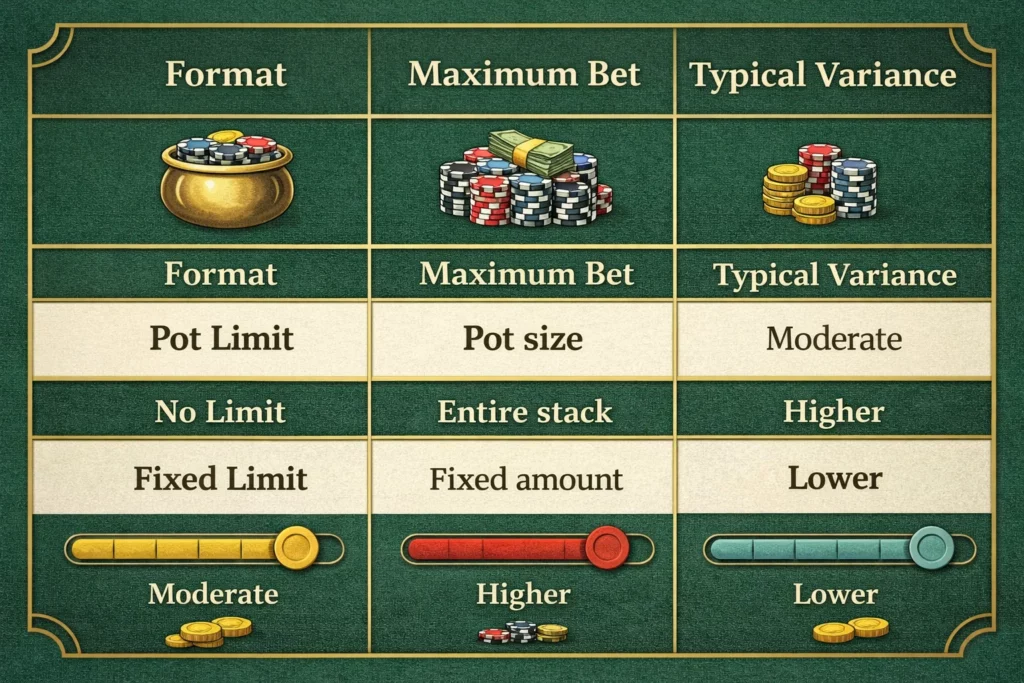
Pot-Limit Omaha is the most popular version online. The maximum bet equals the size of the current pot, which keeps betting aggressive but controlled.
PLO strikes a balance: pots can become large, but no one can instantly bet an unlimited amount without the pot size setting a ceiling first.
No Limit Omaha
In No Limit Omaha, players may bet any amount up to their full stack. This increases volatility and creates more dramatic swings than the pot-limit version.
Fixed Limit Omaha
Fixed Limit games use predetermined bet sizes. The structured increments limit extreme moves and make the pace more measured.
Omaha Hi/Lo (Omaha 8-or-Better)
Omaha Hi/Lo divides the pot between the best high hand and the best qualifying low hand. For the low to qualify, it must consist of five unpaired cards ranked eight or lower.
More details about split-pot formats can be found in Wikipedia’s High-low split.
Each variant changes the math and the pace of the game, so it’s worth trying more than one to see which rhythm actually fits how you like to play.
How Betting Works in Omaha
Pot Limit Betting Explained
In Pot-Limit Omaha, the maximum raise equals the current pot size after calling a bet. If the pot is $100, the largest possible raise is $100.
This structure creates natural, gradual betting growth rather than sudden jumps.
No Limit Betting
In No Limit, players can move all-in at any time. The absence of betting limits changes the psychological dynamic at the table.
Fixed Limit Betting
Fixed Limit structures use consistent, predefined bet sizes:
- larger bets on the turn and river;
- smaller bets in early rounds.
Betting Actions (Fold, Check, Call, Raise)
Players can:
- fold;
- check;
- call;
- raise.
Each decision should reflect both hand strength and board development.
Comparing the Three Betting Structures
Starting Hands in Omaha
What Makes a Strong Starting Hand
In Omaha, good starting hands are coordinated. The four cards should work together rather than sit as four unrelated pieces.
Strong hands usually include:
- connected ranks;
- suited combinations (preferably double-suited);
- multiple straight possibilities;
- high-card support.
Random high cards without structure often struggle, even when every card is a face card or an ace.
Hand Examples (Good vs Avoid)
| Type | Example | Comment |
| Strong | A♠ K♠ Q♦ J♦ | Connected and double-suited |
| Playable | K♠ Q♦ J♣ T♦ | Strong straight potential |
| Weak | A♣ 7♦ 2♠ 9♥ | Poor coordination |
Importance of Suited & Connected Holdings
When your cards are suited and connected, you gain flexibility. You can hit straights, flushes, or even redraws if the board pairs. That flexibility is often the difference between winning and just hoping.
Basic Strategy Principles for Beginners
Importance of Position & Hand Selection
Position matters even more in Omaha than in Hold’em. Acting later gives you more information and more control.
Careful starting hand selection prevents difficult decisions later in the hand.
Drawing Hands & Pot Odds Basics
Omaha frequently becomes a drawing game. Understanding pot odds helps determine whether calling a bet makes sense mathematically. A formal definition can be found in Wikipedia’s Pot odds article.
Avoiding Common Omaha Beginner Mistakes
Common beginner errors include:
- playing too many hands;
- overestimating medium-strength holdings;
- ignoring redraw possibilities;
- misapplying the 2+3 construction rule.
Patience usually pays off.
Omaha Example Hands
Hand Played Through Pre-flop to Showdown
Take the “Strong” hand from the table above, A♠ K♠ Q♦ J♦, connected and double-suited. Pre-flop, this hand plays well from almost any position: it has straight potential in multiple directions and a flush draw available on two different suits.
Say the flop comes T♦ 9♣ 8♠. At this point, Q♦ J♦ paired with the board’s T♦, 9♣, and 8♠ already makes a straight, Queen to Eight. None of the other five two-card combinations from this hand do better: A♠K♠ is just ace-king high with a backdoor flush draw, and the other pairings don’t connect at all. The best five-card hand available is fixed the moment the flop lands, even though the player is holding four cards that could combine several different ways.
By the river, unless the board pairs or a fourth diamond falls to complete a higher hand for an opponent, that straight holds up as the winning hand. The lesson carries beyond this one example: on every street, the question isn’t “what’s my best-looking card combination,” it’s “which exact two hole cards, paired with three board cards, make my strongest legal hand right now.”
Hand Analysis: Winning Hand Breakdown
Winning in Omaha often depends on how well your hand interacts with the board texture, not on how good it looked before the flop. In the example above, the pre-flop hand was strong specifically because it had multiple ways to improve, and the T♦ 9♣ 8♠ flop happened to connect with one of those paths (the Q♦J♦ straight) rather than another (the A♠K♠ flush draw). A different flop could easily have favored the flush draw instead, or missed the hand completely. The best-looking pre-flop hand does not always end up being the winner; it just gives you more roads that could lead there.
How to Play Omaha Online
Picking Your Platform
When choosing an online site, look at:
- available Omaha variants;
- stake options;
- player activity;
- regulatory oversight.
Table Interface & Navigation
Online tables typically include betting controls, pot display, and action buttons. Becoming comfortable with the interface improves your reaction time when the action gets fast.
Choosing Game Types & Stakes
If you’re new to Omaha, starting with lower stakes in Pot-Limit Omaha can help you adapt to the rhythm of the game without unnecessary risk.
Claim a Welcome Bonus
Most rooms that spread Omaha also run a first-deposit match for new players. Terms differ by operator, so check the specific wagering requirements before you count the bonus as part of your working bankroll.
FAQ
How do you win in Omaha Poker?
By forming the strongest five-card hand using exactly two hole cards and three board cards.
What are the most popular Omaha variants?
Pot-Limit Omaha (PLO) and Omaha Hi/Lo.
What is the “2 hole cards + 3 board cards” rule?
It requires players to use exactly two private cards and exactly three community cards to build a hand.
What are the best starting hands in Omaha?
Double-suited, connected high-card combinations.
Can I play Omaha Poker online for real money?
Yes, many licensed platforms offer real-money Omaha games, subject to local regulations.
What are common mistakes beginners make in Omaha?
Overplaying weak hands and misunderstanding the 2+3 rule.
Is Omaha more difficult than Texas Hold’em?
Many players consider it more complex due to additional hole cards and stronger average hands.
Where can I practice Omaha Poker for free online?
Many platforms offer free play or demo tables.