
Omaha Poker Strategy Guide: How to Win Online
If you’ve spent time playing Texas Hold’em and then switch to Omaha poker, the first thing you notice is how different the rhythm feels. The rules may look similar, but the game unfolds in a completely different way. Four hole cards instead of two mean that almost every flop connects with someone. Draws are everywhere, and “decent” hands rarely stay decent for long.
Online Omaha rewards patience and awareness more than constant aggression. The skill lies in knowing when your hand is strong enough to build a pot, and when it only looks strong on the surface. The players who do well long-term are the ones who respect how powerful the nut hands are in this format.
Understanding Omaha Strategy Basics
Why Omaha Requires a Different Strategy Than Hold’em
The extra two hole cards dramatically increase the number of possible combinations. In Hold’em, you can often narrow down what your opponent might have. In Omaha, ranges overlap more frequently, and strong hands collide.
Because of that, hand values shift. Top pair loses importance. Even two pair can feel fragile on a coordinated board. What matters more is whether your hand can realistically become the nuts, the best possible hand available.
A simple mindset change helps: instead of asking “Is my hand strong?”, ask “Is my hand strong enough against multiple draws and better combinations?” That question is the one worth carrying to every flop.
The Importance of Position in Omaha
Position is always important in poker, but in Omaha it becomes a real strategic advantage. Acting last means you see how many players show interest and how confident their betting looks.
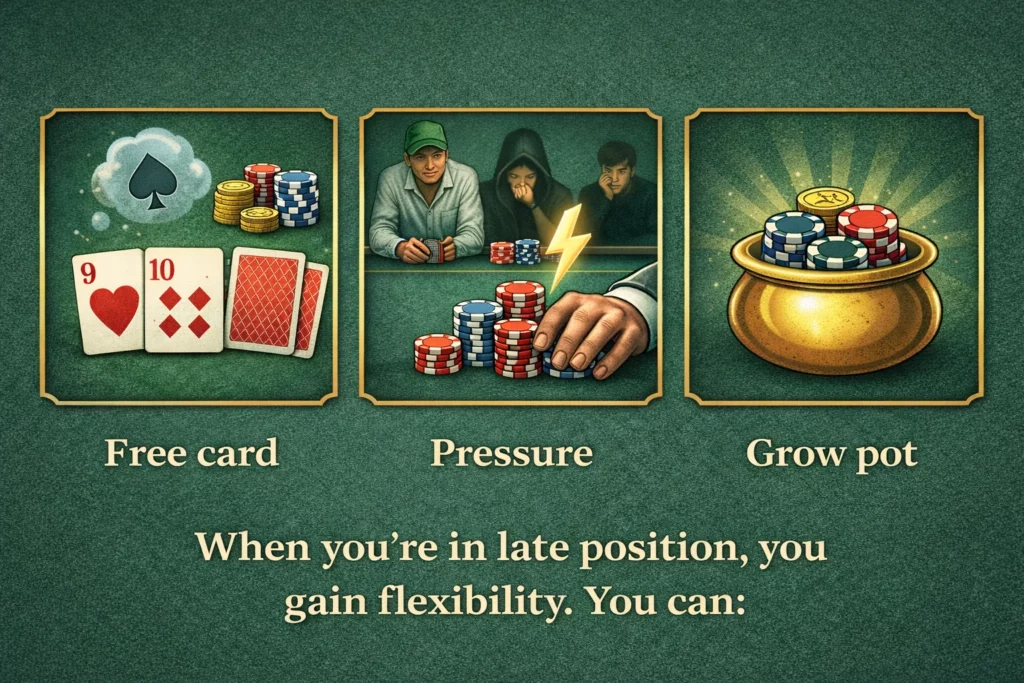
When you’re in late position, you gain flexibility. You can:
- take a free card with drawing hands;
- apply pressure when opponents hesitate;
- control how big the pot becomes.
In early position, things are less forgiving. Playing wide ranges from under the gun often leads to difficult post-flop spots, especially on dynamic boards.
Information is only half of what position buys you. The other half is options: the ability to check a marginal hand back cheaply, or raise for value once you know a table has shown weakness.
Pot Control and Managing Risk
Omaha has a reputation for large pots, especially online. That’s partly because many hands develop into strong draws, and players feel justified continuing. But building big pots with vulnerable hands can quickly backfire.
Managing risk means recognizing when your made hand is likely to face strong redraws. A straight on a two-suited board may look solid, but if opponents can easily hold a flush draw plus straight draw, the situation becomes more complicated.
Slowing down here is simply reading the board for what it actually offers other players, not just what it offers you.
Omaha rewards players who focus on the best possible hand rather than just a good-looking one, and who size their risk to match it.
Pre-Flop Strategy in Omaha
Starting Hand Selection
Pre-flop discipline separates consistent players from gamblers. In Omaha, strong starting hands usually have structure. The cards need to cooperate.
Hands tend to perform well when they are:
- connected in rank;
- suited, ideally double-suited;
- capable of making multiple strong combinations.
A hand like A-K-Q-J double-suited offers several straight and flush possibilities. In contrast, A-A-8-3 rainbow may look impressive, but without coordination it often creates difficult post-flop spots.
It’s easy to get tempted by four “nice-looking” cards. But if they don’t interact well, their value drops significantly.
Position-Based Adjustments
Your position should influence which hands you enter the pot with. From early position, prioritize hands that can make the nuts. You’ll likely face multiple callers, so speculative holdings without strong potential become risky.
In later positions, you can widen your range slightly. Acting after others allows you to evaluate whether your speculative hand has a good price and favorable dynamics.
Online games, especially with regular player pools, reward this kind of adaptation.
Pre-Flop Raising & Calling Guidelines
Raising pre-flop serves two purposes: building value with strong holdings and isolating weaker opponents. Calling can make sense with coordinated drawing hands, especially when you expect a multi-way pot.
What often causes trouble is calling large raises out of position with marginal hands. The more players involved, the higher the chance someone connects harder with the board than you do.
Omaha Hi/Lo Pre-Flop Tips
In Omaha Hi/Lo, you’re not just aiming for the best high hand, you’re also weighing low potential. Starting hands that include A-2 combinations become especially valuable because they open the door to qualifying low hands.
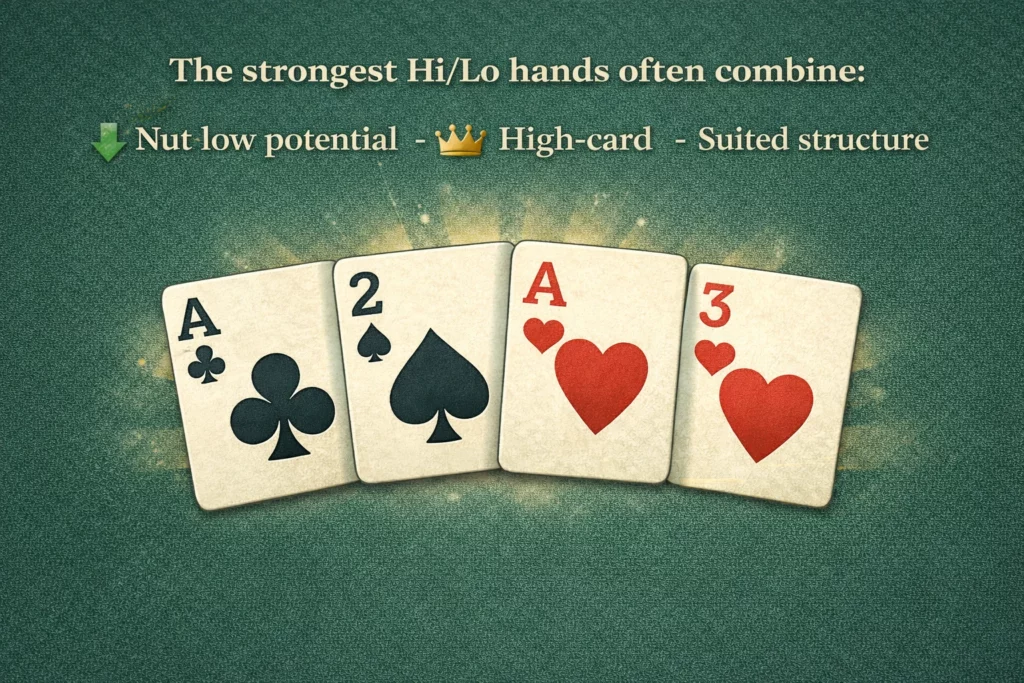
The strongest Hi/Lo hands often combine:
- nut low potential;
- high-card support;
- suited structure.
Hands that can only compete for one half of the pot tend to struggle in multi-way situations. For a deeper look at how the format compares to Hold’em, see our Omaha vs Texas breakdown.
Post-Flop Strategy
Reading the Flop in Omaha
Flop reading in Omaha requires patience. Because players hold four cards, many boards offer multiple drawing paths. You need to assess your hand against the full range of possible nut holdings, not just against what you’re holding in isolation.
When evaluating the flop, consider:
- Is my hand the current nuts or close to it?
- Can I improve to the nuts?
- How many strong draws are possible?
A made hand that cannot withstand future cards is often weaker than it appears.
Continuation Betting (C-Bet) Strategies
Continuation betting works best when the board texture favors your range. In Omaha, highly coordinated boards often hit multiple players at once, so fold equity drops fast on those textures.
Instead of automatic c-bets, think contextually. On dry boards, a continuation bet may work well. On dynamic boards with straight and flush potential, checking sometimes preserves value and avoids unnecessary exposure.
Semi-Bluffing and Value Betting
Semi-bluffing plays a significant role in Omaha. Strong combination draws, a flush draw plus straight draw is the classic example, can justify aggressive betting because of their equity.
Value betting requires more caution. Thin value in Omaha is riskier than in Hold’em because opponents frequently hold redraws. When betting for value, focus on situations where your hand ranks near the top of realistic possibilities.
Pot Odds & Drawing Hands
Omaha naturally creates drawing situations. Understanding pot odds helps determine whether a call is justified over time. The relationship between pot size and call cost should guide your decision.
Say the pot is $80 and you’re facing a $20 bet: calling costs $20 to win a $100 pot, or 5-to-1, which means you need better than a 1-in-6 chance (about 17%) for the call to pay off over time. A single flush draw often clears that bar on its own. A wrap draw combined with a flush draw, a common shape in Omaha, can clear it by a wide margin.
Chasing without proper equity is one of the most common mistakes. Even strong-looking draws can be dominated by better draws holding the same outs.
Omaha Hi/Lo Strategy
Understanding the Split Pot Dynamics
In Hi/Lo, the pot is divided between the best high and best qualifying low. This split dynamic changes how aggressively you pursue hands. Winning both halves, known as scooping, significantly improves profitability compared to splitting the pot with an opponent.
Simply tying for the low half repeatedly limits upside.
Qualifying for Low Hands
To qualify for a low, five unpaired cards ranked eight or lower are required. A-2-3-4-8 qualifies as an 8-high low, for example, while A-2-3-4-9 doesn’t qualify at all, since the 9 breaks the eight-or-under rule. Holding A-2 provides strong low potential, but without high support the hand may only capture part of the pot.
Balancing Your High and Low Potential
The most stable Hi/Lo hands combine nut low potential with realistic high improvement. This balance reduces the risk of being quartered, a situation where you split only half the pot with another player because you shared the exact same low.
Common Mistakes in Omaha Hi/Lo
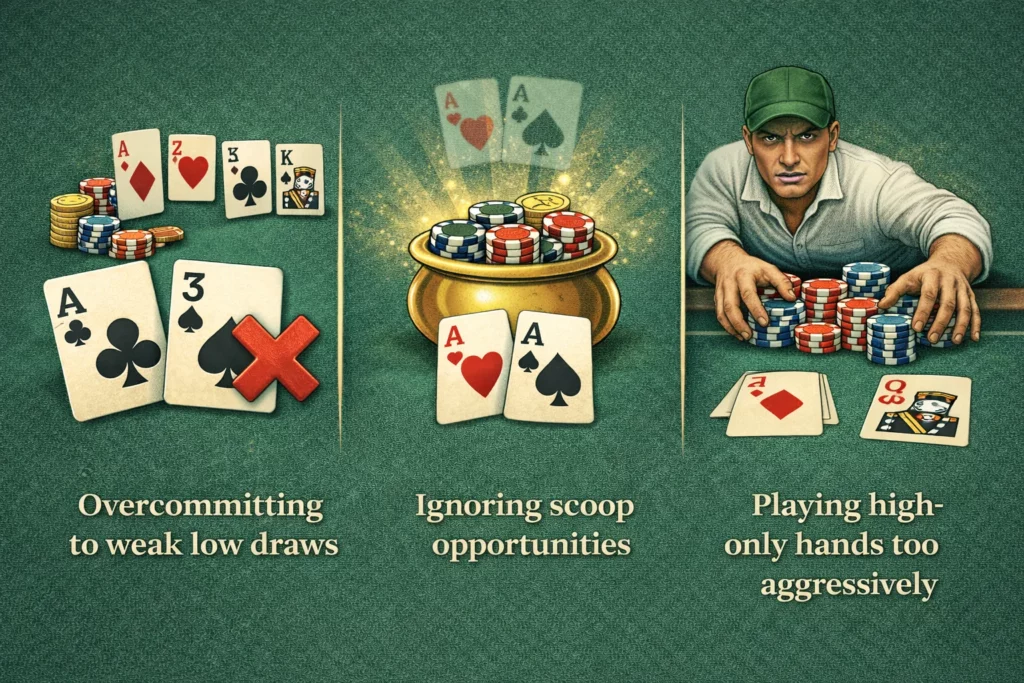
Common issues include:
- overcommitting to weak low draws;
- ignoring scoop opportunities;
- playing high-only hands too aggressively.
Winning the low half of a $200 pot might only return $100, while an opponent who scoops both halves from a similar starting hand walks away with the full amount. Patience and hand structure matter even more in split-pot formats for exactly that reason.
Position & Betting Tactics
Leveraging Late Position
Late position gives you control over tempo. You can decide whether to build the pot or keep it manageable, after watching how everyone else has already acted.
Aggression vs Caution by Position
Aggression is strongest when supported by position and equity. Out of position, over-aggression often creates unnecessary pressure on your own stack instead of your opponent’s.
Sizing Bets for Value and Protection
Bet sizing in Omaha depends heavily on board coordination. Larger bets protect equity on draw-heavy boards, while moderate sizing extracts more value on safer textures.
Common Mistakes and How to Avoid Them
Overvaluing Weak Hands
Two pair and non-nut straights often look stronger than they are. A hand like K-K-3-3 might feel strong pre-flop, but on a board like Q-J-10 it only plays as one pair of Kings, since Omaha lets you use just two of your four hole cards, and an opponent holding 9-8 already has a straight your pair can’t touch. Always consider the possibility of higher combinations before committing more chips.
Chasing Draws Without Odds
Calling without sufficient equity leads to long-term losses. A single-card gutshot with no backup outs is a common example: on its own, it rarely justifies the price, even in a game as draw-heavy as Omaha. Evaluate pot odds carefully before committing chips.
Ignoring Position & Pot Size
Large pots combined with poor position create unnecessary stress. Building a big pot from early position with a hand that only makes the second-best straight is a common way to stack off against exactly the hand that beats you. Controlled pre-flop selection helps avoid these spots.
Misreading Omaha Hi/Lo Pots
Split-pot outcomes reduce profitability in ways that are easy to miscalculate at the table, especially when only half the pot is realistically attainable. Treat a hand that can only win the low half as worth roughly half a scoop, not a full one, when you’re sizing your bets.
Tools & Resources for Omaha Players
Online Tracking Software & HUDs
Tracking tools help identify patterns in your own play and opponents’ tendencies. Used responsibly, they can highlight recurring leaks you might not notice from inside a session.
Practice Sites & Free Play Options
Low-stakes and free-play tables allow experimentation without major financial risk. They are useful for adjusting to Omaha’s pace before moving up in stakes.
Study Plans & Hand Reviews
Reviewing hands after sessions builds deeper understanding. Identifying mistakes in calm analysis, away from the pressure of the table, often surfaces leaks a session alone would miss.
Claim a Welcome Bonus
Make a qualifying deposit and receive a bonus balance for eligible tournaments. Minimum deposit required. Terms apply.
FAQ
What is the best starting hand in Omaha?
Highly connected, double-suited hands such as A-K-Q-J are among the strongest.
How is Omaha strategy different from Texas Hold’em?
Omaha requires tighter selection and greater focus on nut potential because of increased combinations.
Should I play more aggressively or conservatively in Omaha?
Controlled aggression supported by equity tends to produce better results.
What is the difference between Omaha Hi and Omaha Hi/Lo strategy?
Hi focuses solely on the best high hand, while Hi/Lo requires balancing high and low potential.
How important is position in Omaha poker?
Position significantly influences decision-making and risk control.
Can online tools and HUDs improve my Omaha game?
Used properly, they can help refine strategic awareness and consistency.