

Omaha vs Texas Hold’em: Key Differences & Online Strategy
If you’ve ever switched from Texas Hold’em to Omaha poker, you probably felt it immediately: the game looks similar, but it doesn’t play the same. The rules don’t change dramatically on paper, yet the experience at the table does. Pots grow differently. Hands develop differently. Even confidence feels different.
Hold’em often rewards patience and timing. Omaha demands structure and awareness. In Hold’em, you can sometimes “get there” with a decent pair. In Omaha, that same hand might already be crushed before the turn.
Understanding where the games overlap — and where they diverge — makes a real difference, especially online where hands move quickly.
Basic Rules Comparison
Number of Hole Cards
This is the most obvious distinction.
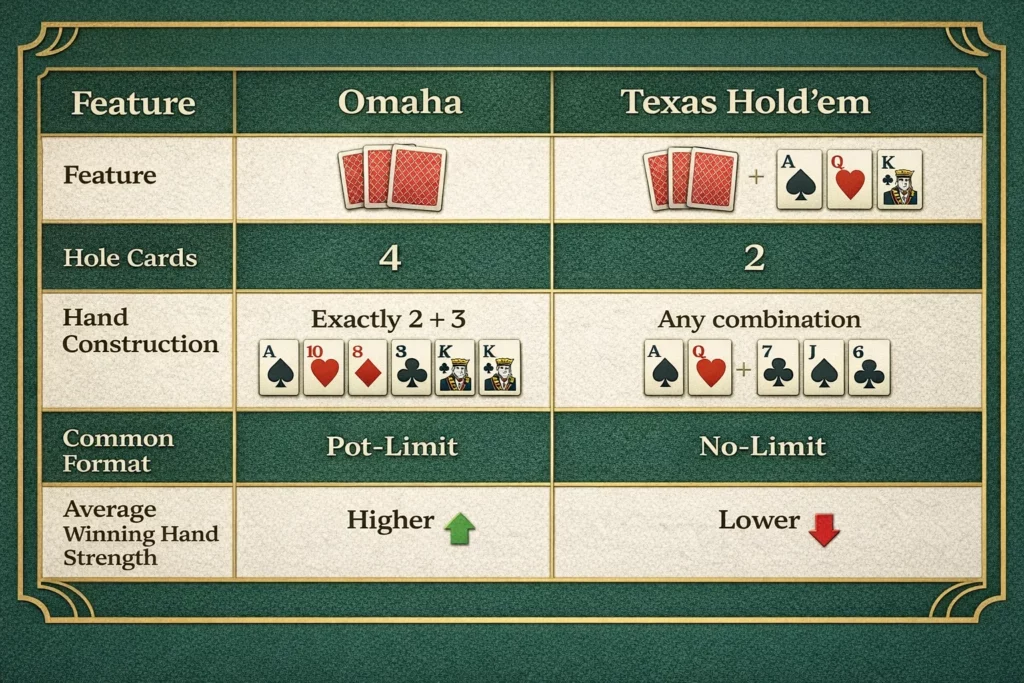
In Texas Hold’em, you receive two private cards.
In Omaha, you receive four.
That change alone reshapes the game. With four cards, players have far more ways to connect with the board. It becomes rare for everyone to completely miss the flop. Someone usually has a draw, and often more than one player does.
In practical terms, stronger hands appear more often in Omaha.
Hand Construction Rules
The next major difference is how hands are built.
In Omaha, you must use exactly two of your hole cards and exactly three community cards. There is no flexibility here.
In Hold’em, you can use any combination of your two cards and the board. Sometimes you even “play the board” entirely.
This rule in Omaha changes how you evaluate both your own hand and your opponents’. A board that looks powerful does not automatically mean you share that strength. You need the right two cards to complete it.
Betting Rounds
Structurally, both games follow the same flow:
- Pre-flop
- Flop
- Turn
- River
Blinds are posted. Cards are dealt. Betting proceeds clockwise.
The rhythm feels similar, but the impact of each card is different because of the number of combinations in play.
Variants Popular Online
Online poker rooms commonly feature:
- No-Limit Texas Hold’em (NLHE)
- Pot-Limit Omaha (PLO)
- Omaha Hi/Lo (8-or-Better)
NLHE remains the most widely played format. PLO is the dominant Omaha version. Hi/Lo introduces split pots and additional complexity.
Omaha vs Hold’em Rules Table – clear side-by-side comparison.
Hand Rankings & Starting Hands
Comparing Hand Strengths
The ranking order of hands does not change. A flush still beats a straight in both games. What changes is how often those hands show up.
Because Omaha players hold four cards, straights and flushes happen more frequently. Two pair in Hold’em can feel strong. In Omaha, two pair is often just a starting point.
This difference forces a mental shift. Instead of asking whether your hand is good, you need to ask whether it is good enough.
Starting Hand Selection Differences
clearly.
In Hold’em, you can profitably play a wide variety of hands depending on position and table dynamics. Suited connectors, small pairs, broadway cards — many of them are viable.
In Omaha, random high cards are rarely sufficient. Strong hands are usually:
- Connected in rank
- Double-suited or at least suited
- Capable of making multiple strong draws
Disconnected hands without synergy tend to create problems later.
Example Hands
strong Hold’em hand:
- A♠ A♦
- K♠ K♦
- A♠ K♠
A strong Omaha hand:
- A♠ K♠ Q♦ J♦ (double-suited and connected)
Omaha strategy starts with understanding starting hands. Notice the difference. In Hold’em, a big pair dominates pre-flop. In Omaha, even aces need support to hold up after the flop.
In Omaha, hand strength and starting hand selection differ greatly from Hold’em. Learn to pick cards with strong potential and win more often.
Strategy Differences
Pre-Flop Strategy
Pre-flop in Hold’em allows for more flexibility. Players can steal blinds, apply pressure, and navigate heads-up situations more frequently.
In Omaha, ranges tighten naturally. Because strong hands are common, entering pots with weak structure leads to trouble. You need connectivity and nut potential from the start.
Loose pre-flop play that works in small Hold’em games often fails in Omaha.
Post-Flop Strategy
Post-flop is where the contrast becomes even clearer.
In Hold’em:
- Pots are often heads-up
- Fold equity matters
- Semi-bluffing can push opponents off marginal hands
In Omaha:
- Multi-way pots are common
- Draws dominate board textures
- Nut potential becomes central
A made hand in Omaha must often survive redraw possibilities. A straight without redraws on a two-suited board can already be vulnerable.
Aggression & Bet Sizing
Hold’em often rewards controlled aggression. A well-timed continuation bet can take down many pots.
In Omaha, aggression without equity is dangerous. Since opponents frequently have strong draws, betting large without backup can create costly situations.
Pot-Limit betting in Omaha also caps maximum raises, shaping how pressure is applied.
Pot-Limit Omaha vs No-Limit Hold’em
How Betting Structures Change Strategy
Pot-Limit Omaha restricts bets to the size of the current pot. This leads to steady pot growth rather than sudden all-in confrontations.
No-Limit Hold’em allows players to move all-in at any moment. This creates sharp decision points and psychological pressure.
The betting structure alone changes variance and emotional dynamics at the table.
Managing Bankroll & Risk in Each Game
Omaha tends to produce larger average pots and more frequent strong hands. This can lead to noticeable swings, especially for players not accustomed to multi-way action.
Hold’em variance depends heavily on style. Tight-aggressive approaches can stabilize results.
In both games, bankroll management matters. But Omaha often demands slightly deeper comfort with volatility.
Common Mistakes When Switching Between Games
Treating Omaha Like Hold’em
Many players underestimate how much tighter Omaha should be played pre-flop. Applying Hold’em habits directly often leads to marginal spots.
Overvaluing Hands in Omaha
Top pair and small straights rarely dominate multi-way pots in Omaha. Overconfidence in medium-strength holdings is a common leak.
Ignoring Position & Board Texture
Position matters in both formats. In Omaha, it becomes critical when navigating draw-heavy boards.
Misreading Multi-Way Pots
Multi-way pots are routine in Omaha. Assuming you are ahead without considering multiple possible draws can be expensive.
Choosing the Right Game for You
Player Skill Level Considerations
Hold’em is generally easier for beginners. Hand evaluation is simpler, and ranges are narrower.
Omaha requires stronger board awareness and combination thinking from the beginning.
Risk Tolerance & Bankroll
Players who prefer steady control may lean toward Hold’em. Those comfortable with bigger pots and more dynamic swings often enjoy Omaha.
Online Availability & Volume of Hands
No-Limit Hold’em offers the highest traffic online. Omaha tables are widely available but usually in smaller numbers.
Which Game Offers Higher Variance or Profit Potential
Omaha often carries higher variance due to strong hands colliding frequently. Some players see opportunity in that complexity, especially at mid-stakes levels.
Hold’em offers enormous volume, but competition is also intense.
Claim a Welcome Bonus
Tournament deposit bonus available. Minimum deposit required. Wagering terms apply.
FAQ
What is the main difference between Omaha and Texas Hold’em?
Omaha uses four hole cards and requires exactly two to build a final hand, while Hold’em uses two cards with flexible construction rules.
Which game is better for beginners: Hold’em or Omaha?
Hold’em is generally easier to learn due to simpler hand evaluation.
Are starting hands in Omaha stronger than in Hold’em?
On average, yes. Four hole cards create more combinations and stronger post-flop possibilities.
How does betting strategy differ between Omaha and Hold’em?
Omaha often involves pot-limit betting and multi-way pots, while Hold’em commonly features no-limit all-in decisions.
Can I use the same tactics from Hold’em in Omaha?
Core poker concepts apply, but ranges and hand valuation must be adjusted significantly.
Which online platforms offer both Omaha and Hold’em games?
Most major online poker sites offer NLHE and PLO as standard formats.